Products >> Herbicides >> Butachlor
Butachlor
Butachlor 50%EW
Butachlor 60%EC
Herbicide
HRAC K3 WSSA 15; chloroacetamide
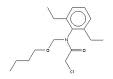
NOMENCLATURE
Common name butachlor (BSI, draft E-ISO, (m) draft F-ISO, ANSI,
WSSA, JMAF); no name (France)
IUPAC name N-butoxymethyl-2-chloro-2',6'-diethylacetanilide
Chemical Abstracts name N-(butoxymethyl)-2-chloro-N-(2,6-diethylphenyl)acetamide
CAS RN [23184-66-9] Development codes CP 53 619 (Monsanto)
APPLICATIONS
Biochemistry Inhibits cell division by blocking protein synthesis.
Mode of action Selective systemic herbicide, absorbed primarily
by the germinating shoots, and secondarily by the roots, with translocation
throughout the plant, giving higher concentrations in vegetative
parts than in reproductive parts. Uses Used pre-emergence for the
control of annual grasses and certain broad-leaved weeds in rice,
both seeded and transplanted. It shows selectivity in barley, cotton,
peanuts, sugar beet, wheat and several brassica crops. Effective
rates range from 1.0-4.5 kg a.i./ha. Activity is dependent on water
availability such as rainfall following treatment, overhead irrigation
or applications to standing water as in rice culture. Phytotoxicity
Non-phytotoxic to rice, cotton, barley, wheat, peanuts, sugar beet,
and some brassicas. Formulation types EC; GR. Selected tradenames:
'Machete' (Monsanto); 'Butanex' (Makhteshim-Agan); 'Butataf' (Rallis);
'Dhanuchlor' (Dhanuka); 'Farmachlor' (Sanonda); 'Hiltaklor' (Hindustan);
'Rasayanchlor' (Krishi Rasayan); 'Trapp' (RPG); 'Wiper' (Nagarjuna
Agrichem)
Butachlor OTHER TRADENAMES
'Ban Weed' (Crop Health); 'Butamach' (BEC); 'Butanox' (Crystal);
'Pilarsete' (Pilarquim); 'Vibuta' (Vipesco) mixtures: 'Bandito'
(+ propanil) (Crystal); 'Sable' (+ propanil) (Proficol); 'Vitanil'
(+ propanil) (Vipesco) Discontinued names mixtures: 'Delcut' * (+
oxadiazon) (Hokko); 'Kusakarin' * (+ pyrazolynate) (Hokko, Sankyo)
Butachlor ANALYSIS
Product analysis by glc with FID (AOAC Methods, 1995, 986.04; CIPAC
Handbook, 1988, D, 17) or by i.r. spectrometry. Residues determined
by glc. In drinking water, by gc with FID (AOAC Methods, 1995, 991.07).
Details available from Monsanto Co.
Butachlor MAMMALIAN TOXICOLOGY
Oral Acute oral LD50 for rats 2000, mice 4747, rabbits >5010
mg/kg. Skin and eye Acute percutaneous LD50 for rabbits >13 000
mg/kg. Moderate skin irritant; practically non-irritating to eyes
(rabbits). Contact sensitisation reactions observed in guinea pigs.
Inhalation LC50 (4 h) for rats >3.34 mg/l air. Other Oncogenic
in rats but not in mice. For detailed toxicology data, please contact
Monsanto. Toxicity class WHO (a.i.) III (Table 5); EPA (formulation)
III
Butachlor ECOTOXICOLOGY
Birds Acute oral LD50 for mallard ducks >4640 mg/kg. Dietary
LC50 (5 d) for mallard ducks >10 000, bobwhite quail 6597 mg/kg
diet. Fish LC50 (96 h) for rainbow trout 0.52, bluegill sunfish
0.44, carp 0.32, channel catfish 0.10-0.14, fathead minnow 0.31
mg/l. Daphnia LC50 (48 h) 2.4 mg/l. Other aquatic spp. LC50 (96
h) for crayfish 26 mg/l. Bees LD50 (contact) >100 mg/bee.
ENVIRONMENTAL FATE
Animals Metabolised to water-soluble metabolites and excreted. Plants
Rapidly metabolised in plants to water-soluble metabolites, leading
eventually to mineralisation. Soil/Environment In soil, degradation
is principally by microbial activity (Y.-L. Chen and T.-C. Wu, Nippon
Noyaku Gakkaishi, 1978, 3, 411). Persists for c. 6-10 weeks. Converted
in soil or water to water-soluble derivatives, with a slow evolution
of CO2.

 86-25-52705499
 George Young