Pesticides >> Insecticide >> Tebufenozide
Tebufenozide 20%SC
Insecticide
diacylhydrazine
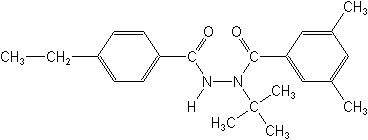
NOMENCLATURE
Common name tebufenozide (BSI, pa E-ISO, ANSI)
IUPAC name N-tert-butyl-N'-(4-ethylbenzoyl)-3,5-dimethylbenzohydrazide
Chemical Abstracts name 3,5-dimethylbenzoic acid 1-(1,1-dimethylethyl)-2-(4-ethylbenzoyl)hydrazide
CAS RN [112410-23-8] Development codes RH-5992; RH-75922 (both Rohm
& Haas)
APPLICATIONS
Biochemistry Ecdysone agonist which acts by binding to the receptor
site of the insect moulting hormone, ecdysone. Mode of action Lethally
accelerates moulting process. Uses Control of lepidopteran larvae
on rice, fruit, row crops, nut crops, vegetables, vines, and forestry,
generally at 0.06-0.3 lb/a. Formulation types DP; GR; SC; SU; WP.
Selected tradenames: 'Confirm' (Rohm & Haas); 'Mimic' (forestry)
(Rohm & Haas); mixtures: 'Conidan' (+ imidacloprid) (Korea)
(Bayer)
OTHER TRADENAMES
'Romdan' (Rohm & Haas, Nihon Nohyaku)
ANALYSIS
Details from Rohm & Haas.
Tebufenozide: MAMMALIAN TOXICOLOGY
Reviews FAO/WHO 77, 79 (see part 2 of the Bibliography). Oral Acute
oral LD50 for rats and mice >5000 mg/kg. Skin and eye Acute percutaneous
LD50 for rats >5000 mg/kg. Non-irritating to eyes and skin (rabbits).
Not a skin sensitiser (guinea pigs). Inhalation LC50 (4 h) for male
rats >4.3, female rats >4.5 mg/l. NOEL (24 mo) for rats 5.5
mg/kg b.w. daily; (18 mo) for mice 8.1 mg/kg b.w. daily; (12 mo)
for dogs 1.9 mg/kg b.w. daily. ADI (JMPR) 0.02 mg/kg b.w. [1996].
Other Negative in the Ames test, reverse mutation assay, mammalian
point mutation (CHO), in vivo and in vitro cytogenetic assay, and
in vitro unscheduled DNA synthesis test. Toxicity class EPA (formulation)
III (2 SC)
Tebufenozide: ECOTOXICOLOGY
Birds Acute oral LD50 for quail >2150 mg/kg. Dietary LC50 (8
d) for mallard ducks and quail >5000 mg/kg. Fish LC50 (96 h)
for rainbow trout 5.7, bluegill sunfish 3.0 mg/l. Daphnia LC50 (48
h) 3.8 mg/l. Algae EC50 (120 h) for Selenastrum >0.64 mg/l; (96
h) for Scenedesmus 0.23 mg/l. Other aquatic spp. LC50 (96 h) for
mysid shrimp (Mysidopsis bahia) 1.4, Eastern oyster (Crassostrea
virginica) 0.64 mg/l. Bees LD50 (96 h, contact) for honeybees >234
mg/bee. Worms LC50 for earthworms >1000 mg/kg. Other beneficial
spp. Safe to predatory mites, wasps and other beneficial species.
Tebufenozide: ENVIRONMENTAL FATE
Animals In the rat, 16 whole-molecule metabolites are formed as
a result of oxidation of the alkyl substituents of the aromatic
rings, primarily at the benzylic positions. Plants In apples, grapes,
rice and sugar beet, the major component is unchanged tebufenozide.
Metabolites which are detected in small amounts result from oxidation
of the alkyl substituents of the aromatic ring, primarily at the
benzylic positions. Soil/Environment Metabolic DT50 in soil 7-66
d (7 soil types); for aerobic, aquatic soil 100 d (25 ºC, 3
soil types); for anaerobic, aquatic metabolism 179 d (25 ºC,
silt loam). DT50 for field dissipation 4-53 d (12 sites). Koc 351-894.
Field dissipation studies indicate no mobility below 30 cm.

 86-25-52705499
 George Young